

Videos illustrating circadian rhythms in plants.
The observation of circadian rhythms in leaf movement of Mimosa plants, which persist in a light-tight box, is generally credited to be the first chronobiology experiment ever performed, back in 1729 by d'Ortous de Mairan. A Gatsby-funded summer student in our lab, Annabel Summerfield, decided to video this leaf movement under constant light conditions in one of our incubators.
Time lapse video showing circadian rhythms in the opening and closing of leaves in Mimosa pudica.
Mimosa leaf signal
For our lab in particular, this rhythm is interesting because the opening and closing of these leaves upon touch are caused by a wave of potassium flux along the leaf within a specialised cell type at base of each leaflet, reminiscent of an electrochemical nerve impulse (right video; real-time). It is therefore likely that the cellular circadian potassium fluxes we recently published sufficiently explain Mimosa circadian leaf movement rhythms, and many other macroscopic plant rhythms.
Video of Mimosa pudica leaves being squeezed to make leaves close shut.
Arabidopsis leaf movement
Leaf movements actually happen in many plant species, including the model plant Arabidopsis thaliana. To the right is a video showing several little plants flapping away.
Leaf movement of the model plant Arabidopsis pictured over several days in constant light conditions.
Luminescent marker gene expression
About a third of all genes in Arabidopsis are expressed in a circadian rhythm. Using an extremely light-sensitive camera, we can visualise the circadian regulation of gene expression in plants that express the firefly luciferase gene, making them rhythmically bioluminescent. The video to the right was made by Samantha Cargill, who wants to use this technology to identify how plant diseases affect timekeeping (and vice versa).
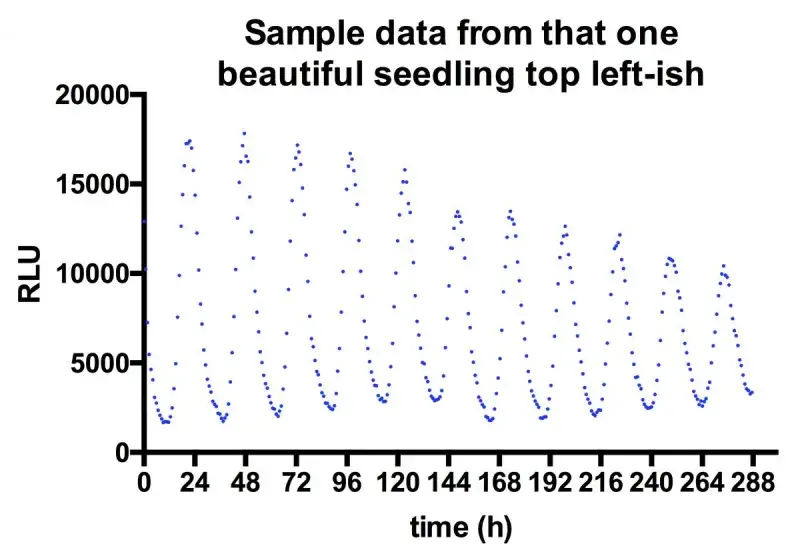
These are Arabidopsis seedlings expressing the luciferase enzyme from either the CCA1 or TOC1 promoter.
Using our videos
If you want to use these videos, please do, but be sure to reference our website.
This article was published on