

The genus Antirrhinum consists of around 25 recognised species that are native to the Mediterranean region. It includes the wild ancestors of the garden snapdragon, A. majus, which has been used in genetics research for over 100 years. Although the species are diverse in form and adapted to different, often extreme environments they can form fertile hybrids with each other and with A. majus, allowing the genes that allow their differences to be identified.
Much of our research examines the genetic basis for plant diversity and adaptation using Antirrhinum (snapdragon) species.
The model genus Antirrhinum
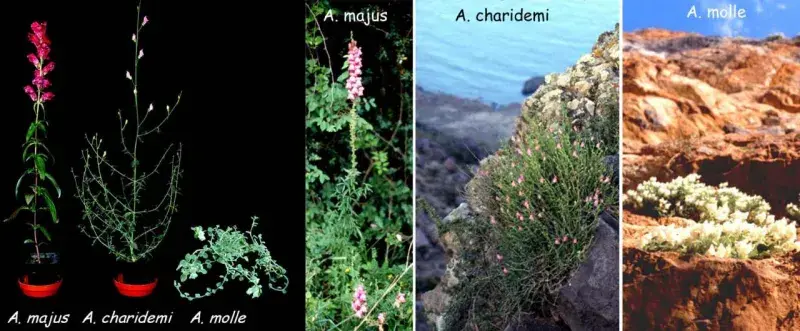
Three species of Antirrhinum, in the wild (right) or grown in a greenhouse (left). A. majus, which has been used as a genetic model since the 1900s1, was likely domesticated from wild populations in SW France and NE Spain, where it grows in lowlands in competition with other plants. A. charidemi is from the driest place in mainland Europe - Cabo de Gata in SE Spain - and has very small leaves and flowers. A. molle is an alpine found on rock faces in the Pyrenees. Like many alpines, its leaves are covered with dense hairs (trichomes), giving them a grey appearance and the plant its name (molle = soft).
We have made genetic recombination maps from hybrids within or between species2,3 and used them to map genes responsible for differences in flower colour, different aspects of morphology including heteroblasty, leaf shape and size4, and the co-evolution of leaves and petals within the genus5. This has been done with collaborators that include Enrico Coen at John Innes Centre. We used experimental and natural hybrids between alpine and lowland species to identify the Hairy gene that is responsible for differences in hairiness between alpine and lowland species6, and developed methods for efficient silencing or over-expression of genes from viral vector in Antirrhinum to confirm its role7.
Plant Hairs
Almost all flowering plant species produce epidermal hairs, known as trichomes. In many species hairs are associated with roles in protecting the plant from pests and stressful environments. The secretions from the hairs of some species are also sources of high-value pharmaceuticals or flavour compounds, and increasing hair density can increase compound yields. Therefore the regulatory network that controls hair formation provides a target for breeding better protected crops or biotechnology. The Hairy gene, which encodes a protein-reducing glutaredoxin, has given us a biochemical handle on the mechanism that specifies hair cell fate in the developing epidermis6. In parallel, we are taking a genetic approach using hybrids between other Antirrhinum species to identify genes in the network that control the length of hairs or whether they develop a secretory gland or non-secretory. With Tessa Moses we are studying the composition of Antirrhinum hair secretions, which appear to protect against pests and contain novel compounds.
To better understand patterns of evolution in Antirrhinum, we have resolved the relationships between its species using genomic data from populations, in collaboration with Alex Twyford8. One finding of this study is that alpines appear to have evolved from lowland forms at least twice. We are now investigating the extent to which this convergent evolution involved recycling of the same mutations and whether mutations were shared between alpine species through hybridisation.
Mining deeper diversity
With Steve Fry's cell wall group, we helped to identify a horsetail gene that encodes the first enzyme known to link cellulose to the hemicelluloses that surround it in the plant cell wall9. Our collaboration continues in a project that uses this enzyme to stiffen the stems of crops, with the aim of reducing losses due to 'lodging'.
References
[1] Schwarz-Sommer Z, Davies B, Hudson A (2003). An everlasting pioneer: the story of Antirrhinum research. Nature Reviews Genetics 4:657-666. https://doi.org/10.1038/nrg1127
[2] Schwarz-Sommer Z, de Andrade Silva E, Berntgen R, Lönnig W-E, Müller A, Nindl I, Stüber K, Wunder J, Saedler H, Gübitz T, Borking A, Golz JF, Ritter E, Hudson A (2003). A linkage map of an F2 hybrid population of Antirrhinum majus and A. molle. Genetics 163:699-701. https://doi.org/10.1093%2Fgenetics%2F163.2.699
[3] Schwarz-Sommer Z, Guebitz T, Weiss J, Gomez di-Marco P, Delgado Benarroch L, Hudson A, Egea-Cortines M (2010). A molecular recombination map for Antirrhinum majus. BMC Plant Biology 10:275. https://doi.org/10.1186/1471-2229-10-275
[4] Langlade NB, Feng X, Dransfield T, Copsey L, Hanna AI, Thébaud C, Bangham A, Hudson A, Coen ES (2005). Evolution through genetically controlled allometry space. Proc. Natl. Acad. Sci USA. 102:10221-6. https://doi.org/10.1073/pnas.0504210102
[5] Feng X, Wilson Y, Bowers J, Kennaway R, Bangham A, Hannah A, Coen E, Hudson A (2009). Evolution of allometry in Antirrhinum. Plant Cell 21:2999-3007. https://doi.org/10.1105/tpc.109.069054
[6] Tan Y, Barnbrook M, Wilson Y, Molnár A, Bukys A, Hudson A (2020). Shared mutations in a novel glutaredoxin repressor of multicellular trichome fate underlie parallel evolution of Antirrhinum species. Current Biology 30:1357-66. https://doi.org/10.1016/j.cub.2020.01.060.
[7] Tan Y, Bukys A, Molár A, Hudson A (2020). Rapid, high efficiency virus-mediated complementation and gene silencing in Antirrhinum. Plant Methods 16:145. https://doi.org/10.1186/s13007-020-00683-5.
[8] Durán-Castillo M, Hudson A, Wilson Y, Field DL, Twyford AD (2021). A phylogeny of Antirrhinum reveals parallel evolution of alpine morphology. New Phytologist 223:1426-39. https://doi.org/10.1111/nph.17581.
[9] Herburger K, Franková L, Pičmanová M, Xin A, Meulewaeter F, Hudson A and Fry SC (2021). Defining natural factors that stimulate and inhibit cellulose:xyloglucan hetero-transglucosylation. The Plant Journal 105:1549-1565. https://doi.org/10.1111/tpj.15131.
This article was published on